Wednesday, November 19, 2014

Only as Good As?

They say a writer is only as good as her last book. True, very true. If you’ve turned out a string of pearls and deliver a lump of coal, that’s what you’ll have to overcome in the next book.

I don’t think I’ve done that yet. Not to brag (OK, it’s bragging), but one reader says each Duckworthy book is better than the last one. I’m not examining that sentiment far enough to see what it says about the first two. Nope, not doing it.

But what occurred to me yesterday, as I completed a scene that I very much like, and one that popped up all on its own, as they are wont to do, is that maybe a writer is only as good as her last chapter. Her last paragraph? Her last sentence?

No wonder writers exist in a constant state of mild anxiety, broken up by periods of sheer terror, usually induced by deadlines.

Am I overthinking this? Maybe not. After all, you can’t stick awful sentences into your paragraphs and just continue on your blithe way. They all have to be crafted. They all have to hang together. Nothing must impede the reader, speeding through your deathless prose, turning the pages into the night—ideally.

When we do put in a stumbling block, we sure do depend on our beta readers to point those out to us so we can smooth the way.

This is very much on my mind as I finish up the second Fat Cat book and embark on the third. The first one was so well received, that I can’t believe the second one will measure up, let alone the third. All I can do is write the best book I can and fling it out there. Talk about a wing and a prayer!


I will add that I depend on my publishers’ editors to keep me on the straight and narrow to producing an entertaining book. However, it’s my name on the cover, right? One of my names, anyway.

This blog is duplicated at Janet's place,http://janetcantrell.blogspot.com/. 

Wednesday, November 12, 2014

Cover Reveal!

I'm so pleased to be able to show you the cover for FAT CAT SPREADS OUT, which will be published June of 2015 if everything goes well and I don't have to do lots of additional rewriting.

Here's the come-on:

Butterscotch tabby Quincy is back and hungrier than ever in this frisky follow-up to Fat Cat at Large
A booth at the Bunyan County Harvest Fair seems like the perfect opportunity for Charity “Chase” Oliver and Anna Larson to promote their Bar None bakery business. Unfortunately, plus-sized pussycat Quincy has plans for their delicious dessert bars other than selling them to customers. After tearing through their inventory, Quincy goes roaming the fairgrounds in search of more delights.
But what he finds is murder. One of the top contenders in a butter-sculpting contest has been killed, and Chase is churning on the inside when she sees Quincy’s handsome veterinarian, Dr. Mike Ramos, being led away by the police. With a little help from a kitty with butter on his whiskers, Chase needs to find the real killer and clear the doctor’s good name….

AND the cover:


You can preorder it already, too. Barnes and Noble, Books A Million, or Amazon.  


Wednesday, November 5, 2014

Post Halloween Thoughts

Thought #1. The same one we usually have. We bought too much candy. This year was worse than
some because it started raining at 7. We got 5 trick or treaters, then, I figure, the fled to the nice warm, dry mall, where candy was also being handed out.

Thought #2. November 2nd was National Cookie Monster Day, but why isn’t it National Leftover Candy Day? That would make sense. Or maybe have that one on November 1st and then follow it with the lovable Monster’s day.

Thought #3. Thanksgiving is next, although it’s hard to discern, since the only commercial value is to the grocery stores. Should we try for a fresh turkey this year? They turn out well, no thawing required. And I have a handy new meat thermometer that I can read outside the oven.

Thought #4. I kind of miss the injected deep-fried turkeys our son
used to make when he was single. And the ones Hubby used to smoke all day on the driveway. Neither of these guys are inclined to do these any more. Things change.

Thought #5. Even though I lament the early advertising for Christmas, I need to get cracking on gifts. I have two packages that I sent overseas and they need to go out this month. Pretty soon, actually. That’s why I shop for Christmas all year long.


Wednesday, October 29, 2014

The Generosity of Other Writers from Terry Shames

I'm so pleased to have Terry Shames on my Travels today! Here's a bit about her and her books:

Terry Shames writes the best-selling Samuel Craddock mystery series, set in the fictitious town of Jarrett Creek, Texas. Her first novel, A Killing at Cotton Hill (July 2013) was a finalist for the Left Coast Crime award for best mystery of 2013, the Strand Magazine Critics Award, and a Macavity Award for Best First Novel of 2013. MysteryPeople named it one of the five top debut mysteries of 2013.


The Last Death of Jack Harbin (January 2013) was named one of the top five mysteries of 2013 by Library Journal. Dead Broke in Jarrett Creek came out October, 2014. A Deadly Affair at Bobtail Ridge comes out in April, 2015.

And now, her essay on The Generosity of Other Writers, something I should blog about more often myself.

Tomorrow night I’ll be appearing at a local bookstore in the Bay Area. It’s advertised as “In Conversation” with another author, Keith Raffel. Ever since I was first published a year ago last July, Keith has kept up a constant drumbeat for my books. There’s no quid pro quo here—he does the same for other writers as well, and as far as I can tell expects nothing in return. Now as it happens, I like Keith’s books and am only two happy to reciprocate. We’re both working hard to make our books stand out in a sea of good books. And there are other authors who do the same thing—Susan Shea, Cara Black, Sheldon Siegel, and Sophie Littlefield to name a few.

I’ve had other writers offer to push my books—in return for doing the same for theirs. I’m not put off by that request. I know that all but the most successful writers struggle to find innovative ways to make their voices heard. Many of us feel embarrassed to beat our own drums. But I read a wonderful thought that made me feel better about it. The writer said not to be embarrassed, that after all we wanted people to read our books. Promotion is just a way to make sure people know about the books. We can’t make people read them or like them—but we can at least introduce readers to them.

That’s why it’s even more precious when a successful writer puts the word out without expectation of return. The first person who did that for me was Carolyn Hart. Speaking to the audience at Malice Domestic 2013, she mentioned my first book as one she had recently read and liked. Since then, I’ve been astonished by the way other writers with thriving careers take time out of their busy lives to promote their fellow-authors. I’ve been gratified when I asked for blurbs from writers I admire and they said, “of course.” For me to try to reciprocate for most of them, who are at the top of the heap, would be like adding a cup of sand to a beach.

The only way I know to pay those authors back is to pay it forward for new ones. I love it when someone at a reading asks me what authors I enjoy. I mention a few of the standards—Deborah Crombie, Michael Connelly, Rhys Bowen, and Hank Phillipi Ryan—but I also make sure to slip in a few authors I’ve recently discovered and enjoyed—Frank Hayes, Lynne Raimondo, JCarson Black, and Lori Rader-Day. People are starting to ask me to blurb their books, and I’ve been really lucky to find some gems: Andrew MacRae and Anonymous-9 to name a couple. I’m delighted to do for them what generous writers have done for me.

Writers are in a hard business—with an emphasis on the word “business.” I think we’re lucky that it’s a business full of generous people, willing to help each other out.

Who are some of the new writers you’ve discovered recently?

Kaye again. I want to tell you a bit about Terry's latest, Dead Broke in Jarrett Creek:  With Jarrett Creek bankrupt and the police department in disarray, Samuel Craddock becomes temporary chief of police by default. Faced with a murder investigation, Craddock discovers that the town’s financial woes had nothing to do with incompetence and that murder is only one of the crimes he has to solve.

Please visit Terry at http://terryshames.com/ to learn more about her and the series.

Wednesday, October 15, 2014

Guest Today, Mary Black, Prehistory Writer

Mary Black is a fellow writer of prehistory fiction! I'm so sorry I didn't get to meet her when I lived in Austin. But at least we're connected now.

About the Author:  Mary S. Black fell in love with the Lower Pecos more than twenty years ago.  Since then she has studied the archaeology and related ethnography of the area with numerous scholars.  She has an Ed.D. from Harvard University in Human Development and Psychology and lives in Austin with her husband, an archaeologist, and two cats.


Peyote Fire
Shaman of the Canyons


Mary S. Black

Also on Facebook and Goodreads


            Peyote Fire is set in a real place that still exists on the border of Texas and Mexico, only 4,000 years ago.  The same rivers and canyons are still there, the same dry, rugged uplands.  It’s the kind of place that if you’re driving fast on the highway, you’d never notice the beauty and mystery that exists. But if you prowl among the canyons, you discover magical art on the stone walls and other remains left there by the people so long ago. In fact, over 300 rock art sites have been documented in that area by researchers. What were those ancient people trying to say? The art is so abstract and complex, it is difficult for modern people to understand. We just don’t have the same frame of reference.
            That’s what really spurred me to write this book: wondering what the art was all about. Who were those people? What was so important that they wanted future generations to know? The art itself is known as Lower Pecos style and is painted in five colors: red, orange, gold, white and black. Some of the figures could be people, some might be animals, but many others are like nothing we know today.  The pigments were all made from natural minerals.
            The protagonist of my book is painting one of these murals, and you can actually visit it today.  I’ve been lucky to tag along with several archaeologists and others to see these paintings, and hear experts speculate about what they all mean.  Sometimes we think that nobody lived in North America until 1620 when the Pilgrims came.  At least that’s what I was taught growing up, but people have actually been here over 12,000 years! They had to be strong and ingenious to survive.
            Part of what I want to do is expand our understanding of the people who came before us, and tell a good story while doing it. The people in the book tell many stories around the campfire, and those scenes were particularly fun to write.  I based many of these on Native American myths and folk tales, so there are lots of talking animals, but be forewarned, these are not bedtime stories!

Wednesday, October 1, 2014

A GIFT FOR YOU!


I’m not posting next week, so I’ll try to make it up to my blog followers this week. I’ve had one free audio story on my webpage for some time, but just added a second one today. Two free stories!

The first is a hard-bitten little tale about love gone bad in Texas. The second is about cleanup after Hurricane Katrina. They both have good endings! I hope you enjoy them.


Wednesday, September 24, 2014

Guest Kathleen Rollins on Story Roots


I'm delighted to host a fellow writer of prehistory fiction today, Kathleen Rollins. Please join her journey back in time and across continents. She shares my idea that our ancestors were not dumb savages, but real people. It's so fun to find authors with similar views!

What Lies at the Root of Your Stories
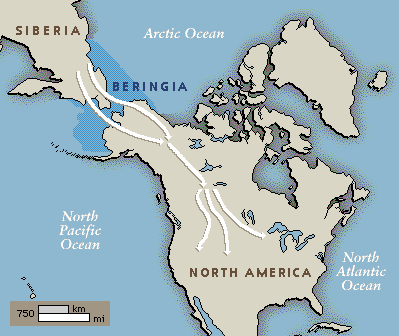
After retiring from teaching composition and literature and doing freelance business and technical writing, I wanted to write my own stories.  Specifically, I wanted to build a big adventure series around the idea that early explorers in the Americas came from many different places at different times.  I’ve always found it hard to believe the Beringia/Land Bridge Theory, which holds that the first people in the Americas arrived here by walking across the Land Bridge from Siberia to Alaska 13,000 years ago and from there populated the rest of the Americas (diagram).  Instead, the explorers in my stories come from West Africa, the South Pacific Islands, and northern Spain.  This is not to say that some people didn’t cross into the Americas through Beringia – just not all of them.

In the Misfits and Heroes stories, I wanted the explorers finding the New World to be both heroic and flawed, capable of the whole range of human emotion and possessed of a relatively sophisticated language.  Absolutely no grunting and pointing dimwits allowed.  It’s simply not credible that people would build housing, make rope, tie knots, handle boats on rivers and open sea, and amass a huge inventory of edible and medicinal plants the way they did at the Monte Verde, Chile settlement, dated to 14,800 years ago, if they had no language.

West from Africa: A Controversial theory 
  The travelers in the first book in the series, Misfits and Heroes: West from Africa, cross the Atlantic from West Africa to the Gulf of Mexico.  Though archaeologists are reluctant to admit travel across the Atlantic would have been possible 14,000 years ago, open water travel had been undertaken by the original inhabitants of Australia at least 50,000 years earlier. 

Wind and water currents would carry West African travelers across the Atlantic right to the Americas.  A young woman named Katie Spotz rowed from West Africa to South America in 70 days – solo – in 2010. 

With the help of primitive sails, the travel time for ancient seafarers could be cut in half.  A lot shorter than walking from Siberia, in any case.

Another find bolsters the West Africa thesis: Pedra Furada, a cluster of archaeological sites in northeastern Brazil, which has returned human habitation dates ranging from 32.000 to 48,000 years ago, twenty thousand years before the ice-free corridor is supposed to have allowed humans to travel from Siberia to Alaska and from there to the rest of the Americas. (Pedra Furada rock art, photo) 

The closest land mass to northeastern Brazil is Africa, not Asia.  Academic resentment and entrenched thinking stands in the way of accepting this route.  But it drives the plot in my first book.

More controversy


The group in the second book, Past the Last Island, comes across the South Pacific (marked by the
dark line on the map) starting in what is now eastern Indonesia, which would have a cross-roads of cultures from Asia, Australia, and the Pacific Islands). Those banished from their island homes as well as those too restless to stay put would have to set out into the unknown, forced by necessity to learn what they could about new islands, boats, ropes, tools, ocean currents, kelp, shore birds, navigation by stars, whatever anyone could teach them or they could figure out on their own.  Experimentation wouldn’t be a luxury; it would be a necessity, especially as the Ice Age faded and sea levels rose, drowning old coastal villages and the history they held.  A clever misfit might well prove to be a hero when the old ways failed.

Where the travelers in the first book are forced to learn about the sea once they’re drawn out into open water and can’t get back to shore, the expert seafarers in the second book purposely choose to see what lies beyond the edge of the world.  Not as surprising as it might seem at first.  These people were the greatest open water navigators in the world, capable of sailing from island to island, even at night and out of sight of land, charting positions by the stars and reading them by lining up marks on their boats, reading changing currents by lying flat on the floor of their boat.  They sailed from Polynesia to the Hawaiian Islands and Easter Island, both thousands of miles away from the nearest land.  Obviously, they were drawn to attempt the supposedly impossible journey. 

In the third book, A Meeting of Clans, members of the two very different groups meet for the first time and change the world.

Animism
In all the books in the series, the people share similar animist beliefs.  They feel all elements of the universe are possessed of a spirit and these spirits together power the world and influence every action within it, including human lives.  Spirits, when active, can take a variety of forms, including human. Signs and omens are terribly important.

While all areas of the natural world possess a spirit, that spirit energy is particularly concentrated in certain places, such as specific mountains, very old trees, deep forest glens, caves, rivers, waterfalls, even particular stones.

The measure of a person would be not just physical stature or possessions but rather his or her connections with the spirit power that flows throughout the universe.  (This basic animist belief is also “The Force” in Star Wars.)

By chance and by choice, some people embraced the spirit connection more than others.  Someone who chose to develop this connection became the shaman, someone who enjoyed the ability to cross between the three worlds (Underworld of the dead, Center World of the living, and Otherworld of the spirits) at the cost of never fully belonging to any of them.  He or she remained the person apart, revered, feared, sometimes resented.  In my stories, shamans have magical powers but they’re also isolated and thus less than fully human.

In rock art images, the shaman is often shown accompanied by animal guides, especially snakes.  Sometimes the shaman seems to be flying, sometimes morphing into something more than human: a human with bird claws and wings, a combination of human and mountain lion, human and stag, or others.


(Photo left: shaman, Panther Cave, Lower Pecos, Texas; middle photo: entranced shaman figures with serpents, rock art panel, Utah; right photo: winged shaman flying out of a hole, Texas)

Magical realism vs. Realism
While the concept of the shaman morphing into some other form in order to connect with the spirits may seems fantastic to us, it probably seemed normal to many ancient people. For them, the magical spirit world wasn’t unreal.  Gabriel Garcia Marquez said his fictional world, which many refer to as “magical realism” was simply the world his grandmother spoke of, in which magic was an intrinsic part of the universe, a world that included spirits as surely as it included people and insects, rivers and clouds.

I find this view easy to understand.  Ancient people saw their ancestors in the mountains and their future in the stars.  We see only rocks and points of light. They saw the natural world as their mother and father; we see it as our property to destroy as we wish.  Perhaps we have the smaller, poorer view.   

Kaye George asked if my views resulted from my travels.  Yes, definitely.  When I was in Bolivia, I joined a celebration that involved a lot of coca and home brew.  Everyone poured the first drink on the ground.  “For Pacha Mama” one man said, “For Mother Earth.”  It took me a moment to realize, “Yes, of course. She’s giving us this party.” 

In a little town in Guatemala, I visited a local cave called La Ventana (The Window).  Ancient Maya saw caves as entrances to the underworld.  Modern Maya leave piles of fresh flowers and rows of candles in La Ventana, some now bearing the images of Christ and the Virgin Mary. The cave is still a portal – a window into the home of the spirits and the dead.   


Thank you, Kaye George, for inviting me to talk about my stories! 

Here’s the info on the books:

The Misfits and Heroes books are available on line at Amazon.com and Barnes and Noble.


Awards include 5-star reviews from Foreword Clarion Reviews and Readers’ Favorite (all three). Kirkus Best of 2011 (the first book), BRAG medallion (the second), Indie Reader 5-star reviews (first and third), Pinnacle Book Award winner (third).

While the books are designed to be a series, you can read and follow any one of them without reading the others.  The books have their own website at www.misfitsandheroes.com and their own blog at http://misfitsandheroes.wordpress.com though I have to say the blog has morphed into a general discussion of all things ancient and their echoes in the present rather than just a discussion of the books.  I hope you’ll check it out!